







Balancing the West-East Education
Dr. Djuwari, Director of Language Laboratory, STIE Perbanas Surabaya
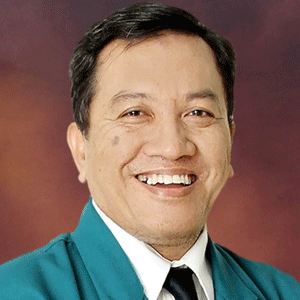
Dr. Djuwari, Director of Language Laboratory, STIE Perbanas Surabaya
Scholars around the world have recognized that the highest university world ranking in webometric.com is mostly dominated by the West universities. Especially, mostly the highest ranking levels are dominated by the universities in the USA. The world appears oblique in terms of science and technology. Science has developed so fast and it must be supported by the high-tech education instruments. These two—science and technology—drag any nations into prosperity.
Universities are a collection of faculties with their feasible environments—educational environments. Strategies and methods in the process of learning and teaching are derived blatantly from the complementary factors: science and technology. In webometrics.com, for instance, one of the criteria being listed and lifted up for its ranking level is the appearance in internets, especially in Google or Google scholars.
When talking about internets and its networking and connection, there must be an obvious educated guess. The West universities happen to be very lucky. They can be exposed automatically due to their visibility supported by their internets connection. It is high-tech instrument that makes all the highest ranking levels in webometrivcs.com. Thus, at a glance, it appears more blatantly the ranking system is supported by the high-tech availability.
Yet, education is a number-one factor—among other factors— for changing the nation into better life and future. The development in education requires balancing among the nations. The oblique condition in education throughout the world will make the world public impaired. Achieving the world peace for all nations find it difficult for there are always discrepancies among the nations that is the imbalanced education.
Science and technology should be shared in balanced position in the world by the world public. This imbalanced condition leads to the imbalanced scholarly nations. It can drag the nations into being more problematic. Negotiations and arguments tend to be in widely-different gaps.
The imbalance education among the nations throughout the world is pseudo-recognition. It means that the world public tends to ignore the negative impacts. Imbalanced condition can be learned from the Brexit (British exit) from the European Union (EU). In economic condition, the imbalanced condition appears vivid. It is obviously recognized. The competitive advantage is the key to success while those that are less competitive tend to be the losers.
Brexit is the phenomenon of imbalanced condition. Education should have been recognized by the world public. Chaos in the globe exists must be due to the imbalanced education. Look again, the webometrics.com. It is obviously that the highest ranking level universities are supported by their infrastructures in high-tech instruments. They are the instruments that support the education process.
For Brexit, the people in the UK could do a referendum and the fact they exit from the EU. How about the education imbalance among the nations in the world? There is no action but the turbulence runs very fast without being recognized, the impacts of the world lives. Imbalanced education among the nations in the world must have several impacts.
Social, cultural, psychological, and even political effects are multi-dimensionally immerged. Unfortunately, these impacts come up on the surface of the world public seems to be unobserved by the blatant eyes—the world public eyes. Social, cultural, psychological, and, of course, unbearable political discrepancies come up together—becoming the massive world burden.
There must be world public figures to take actions. Infrastructures in education system, including strategies and learning process should be enhanced among the whole nations throughout the world. The leaders in any nations or countries can foster their education departments through their education ministers to work hand-in-hand for collaborations. This collaboration can be started by exchange programs and even involving the economic departments.
They should work by direct investment in the countries that require education system development. By doing this, the gap among the nations for science and technology development can be overcome. By this collaboration, the world public can live in a balanced condition. The actions are in relation to science and high-tech education infrastructures among the nations. Science and high-tech development are the complementary factors. Balancing this couple can make the world peaceful and better life among the nations.
