












The changing face of technology enhanced learning
Michael Sankey, Director, Learning Transformations, Griffith University and President of the Australasian Council on Open, Distance and eLearning (ACODE)

Michael Sankey, Director, Learning Transformations, Griffith University and President of the Australasian Council on Open, Distance and eLearning (ACODE)
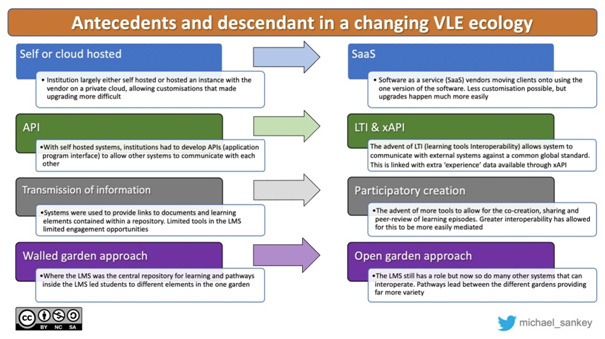 Figure 1. VLE Antecedents
We have largely moved away from self-hosted and cloud-hosted systems to a software as a service (SaaS) model. This has allowed for a simplification in the way we use these tools and a reduction in the number customisations required. As we have moved to SaaS, we have found the LTIs and xAPIs are giving us far more latitude with integrating other systems that share common interests. Not to mention the ability to share important data.
This shift has coincided with changes in the way our academics work with students; moving from an instructivist to a constructivist approaches to learning. This push has been building for decades, but only more recently have our systems allowed us to do this more seamlessly. As a consequence, we no-longer use our systems to just transmit information (loading PDFs and PowerPoints), but we now expect our students to participate and co-construct their learning. Interestingly, this is largely taking place outside the bounds of traditional LMS, where we once constrained our students (it was too dangerous out in the wilds of the internet). We have moved from a walled garden to an open garden approach, largely thanks to integrating external systems into our VLE.
Figure 1. VLE Antecedents
We have largely moved away from self-hosted and cloud-hosted systems to a software as a service (SaaS) model. This has allowed for a simplification in the way we use these tools and a reduction in the number customisations required. As we have moved to SaaS, we have found the LTIs and xAPIs are giving us far more latitude with integrating other systems that share common interests. Not to mention the ability to share important data.
This shift has coincided with changes in the way our academics work with students; moving from an instructivist to a constructivist approaches to learning. This push has been building for decades, but only more recently have our systems allowed us to do this more seamlessly. As a consequence, we no-longer use our systems to just transmit information (loading PDFs and PowerPoints), but we now expect our students to participate and co-construct their learning. Interestingly, this is largely taking place outside the bounds of traditional LMS, where we once constrained our students (it was too dangerous out in the wilds of the internet). We have moved from a walled garden to an open garden approach, largely thanks to integrating external systems into our VLE.
This is not to suggest the LMS is at end of life (yet) but it does acknowledgement that the LMS cannot be all things to all people, and that by necessity institutions have evolved to using a broad range of tools that form more of an ecology.
This ecology relies on the ability to manage one’s student cohort, and the data related to this can be communicated consistently across platforms. Additionally, our systems need to have a relationship with tools that sit outside the control of the institution (despite these now being SaaS).
But probably the most significant trend we have seen over recent years is a shift to utilizing productivity tools. Tools such as Microsoft Teams, Slack and Google. For example, in the institution I work, over 600 courses/units have used Microsoft Teams in 2020 to mediate some or most of their activities.
There are two main drivers for this. Firstly, a greater emphasis is placed on collaboration and the thought that students can be productive, rather than just being empty vessels waiting to be filled. This has led to implementing more active, collaborative and authentic approaches to learning and teaching, but the LMS has not kept up. The second driver is the emphasis placed on preparing students for the workforce and them using the tools and techniques used in the workplace. Clearly this not an LMS, but it tools like Teams, etc.
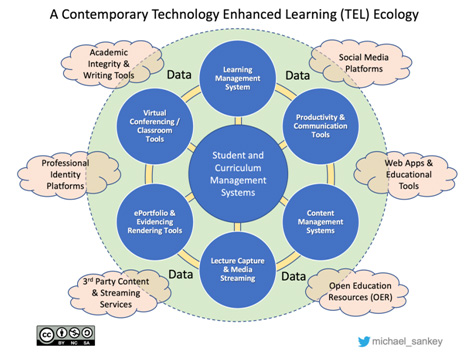 Figure 2. A view of a contemporary learning ecology
So to conclude this short article, as an educator, I would like to provide a view of what is meant by active, collaborative and authentic learning.
Active learningis where we engage students at an analytical level, helping them assimilate material/information rather than passively absorbing it through traditional lectures. So,we design tasks requiring a deeper approach to learning, by using techniques such as, active discussions, problem solving, case-based learning, simulations, role play, peer learning and team projects.
Similarly, collaborative learning relies on engaging group structures, with students working together while maximising individual learning, allowing them to capitalise on one another’s resources/skills. For example, peer modelling, group role play, online scavenger hunts to gather information related to a weekly topic. Formal or informal debates, or a ‘Pass the Problem’, where students partly answer and then pass to the next student.
Lastly, authentic learning, where students gain experience, learning by doing rather than by listening; we let them discuss, explore and construct concepts, to discover real word relationships. We encourage them to critically evaluate information and data, to gain knowledge and build professional identity. We expose them to various settings, activities and perspectives, allowing them to collaborate, and practice skills in various environments. We set them problems that are ill-defined and not easily solvable, with many possible solutions/outcomes.
The above charts a change that has happened in our approach to learning and teaching that has been possible because 1) we have evolved our ways of teaching that has consequently 2) allowed us to evolve the systems we need to perform these tasks.
Figure 2. A view of a contemporary learning ecology
So to conclude this short article, as an educator, I would like to provide a view of what is meant by active, collaborative and authentic learning.
Active learningis where we engage students at an analytical level, helping them assimilate material/information rather than passively absorbing it through traditional lectures. So,we design tasks requiring a deeper approach to learning, by using techniques such as, active discussions, problem solving, case-based learning, simulations, role play, peer learning and team projects.
Similarly, collaborative learning relies on engaging group structures, with students working together while maximising individual learning, allowing them to capitalise on one another’s resources/skills. For example, peer modelling, group role play, online scavenger hunts to gather information related to a weekly topic. Formal or informal debates, or a ‘Pass the Problem’, where students partly answer and then pass to the next student.
Lastly, authentic learning, where students gain experience, learning by doing rather than by listening; we let them discuss, explore and construct concepts, to discover real word relationships. We encourage them to critically evaluate information and data, to gain knowledge and build professional identity. We expose them to various settings, activities and perspectives, allowing them to collaborate, and practice skills in various environments. We set them problems that are ill-defined and not easily solvable, with many possible solutions/outcomes.
The above charts a change that has happened in our approach to learning and teaching that has been possible because 1) we have evolved our ways of teaching that has consequently 2) allowed us to evolve the systems we need to perform these tasks.
Figure 2. A view of a contemporary learning ecology
So to conclude this short article, as an educator, I would like to provide a view of what is meant by active, collaborative and authentic learning.
Active learningis where we engage students at an analytical level, helping them assimilate material/information rather than passively absorbing it through traditional lectures. So,we design tasks requiring a deeper approach to learning, by using techniques such as, active discussions, problem solving, case-based learning, simulations, role play, peer learning and team projects.
Similarly, collaborative learning relies on engaging group structures, with students working together while maximising individual learning, allowing them to capitalise on one another’s resources/skills. For example, peer modelling, group role play, online scavenger hunts to gather information related to a weekly topic. Formal or informal debates, or a ‘Pass the Problem’, where students partly answer and then pass to the next student.
Lastly, authentic learning, where students gain experience, learning by doing rather than by listening; we let them discuss, explore and construct concepts, to discover real word relationships. We encourage them to critically evaluate information and data, to gain knowledge and build professional identity. We expose them to various settings, activities and perspectives, allowing them to collaborate, and practice skills in various environments. We set them problems that are ill-defined and not easily solvable, with many possible solutions/outcomes.
The above charts a change that has happened in our approach to learning and teaching that has been possible because 1) we have evolved our ways of teaching that has consequently 2) allowed us to evolve the systems we need to perform these tasks. 
