

A featured contribution from Leadership Perspectives: a curated forum reserved for leaders nominated by our subscribers and vetted by the Construction Tech Review Advisory Board.

S P Jain School of Global Management
3D Your New Workforce

Dr. CJ Meadows
The fear of a General facing an unstructured life was shared with my friend, a former Managing Partner at Accenture. My friend and I worked together after my days building IT for Accenture, while I crafted corporate strategies and organizational structures for Accenture clients, before becoming an academic, an entrepreneur, and a not-for-profit founder. I’ve made career transitions I wanted to make and some I didn’t.
Now others face on a massive scale transitions they wouldn’t choose on their own. They face choices they don’t know how to make, as individuals and for organizations.
Why? As every technology leader knows, advanced technologies like AI, machine learning (ML), robotic process automation (RPA), and more will take over bits of what humans do less well. Jobs will be redesigned for humans to take human tasks best done by us, and for cobots to do the tasks best done by bots and systems. Consultants and researchers are busily envisioning the Future of Work and exactly what kind of man-machine synergy we’ll enact in Industry 4.0.
Bots and systems will need humans to craft them, until they start crafting themselves more reliably. (So,more work & skills are needed among humans.) Individuals will need to learn how to work with their cobots (so, there’s an HR/educational need, too). Organizations need to plan their future workforces with help (of course) from technology, such as the workforce planning tool at Deloitte’s Future of Work Center of Excellence. Once you’ve mapped in today’s workforce and told the tool your industry and place in it, it predicts the workforce you’ll need in the next few years. There’s only one question left to ask:
Now what?
The average leader actually does know that firing 45% of a company’s workforce is a bad idea (if we use a percentage from the popular “Humans Need Not Apply” video). The leaders I’ve spoken to have all said they’d rather not gut their organizations, pay for massive churn, destroy the cultures they’ve tried to build, and find themselves unable to hire people with the new skillsets they need because there aren’t enough people to go around.
It’ll be cheaper and more effective to Diagnose the people they already have, Develop them, and Deploy them into the new jobs – essentially 3D “printing” a new workforce.
My own transitions taught me the key is a combination of latent talent, skills development, and opportunity. Matching these three is a massive undertaking for an individual, let alone an organization of hundreds, thousands, or hundreds of thousands.AI engines are needed for the matching process. In fact, technology infrastructures will also be key for tracking all of the above and continually coordinating tasks which are dynamically reconfigured into jobs that fit individuals, not individuals force-fitted into jobs. Organizational structures will no longer be drawn on PowerPoint but will be presented online by an AI bot as a continually-changing human-net.
Do you have that infrastructure in place?
Assuming you have systems to depict today’s workforce and you use a tool to predict tomorrow’s, you’ll need to break apart your Lego mansion of jobs into Lego-brick-type tasks and identify what you need a human for vs. tech and what interplay will be necessary between them, some of which are themselves new jobs already being hired, e.g. AI ethicist, ML educator, and RPA auditor.
What kind of human do you want for each task? Someone “good with people”? Logical/analytical? An organized “do-er”? “Creative”? With what particular skills?Whether you’re matching a person with a job or with task(s), whether for short-term work or long-term, the new age of work will require that you know more than whether they’re certified in a particular skill.
D1 – Diagnose: Working relationships among individuals, teams, and organizations will remain stickier than the tasks they perform.
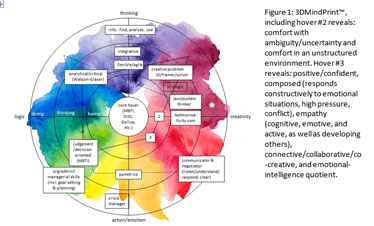
Wouldn’t be great if you could see a fingerprint of someone’s mind, as well as particular skills in which they’re certified? Essentially, you can (see Figure 1). Based on research presented in the World Economic Forum’s “Future of Jobs” report, Deloitte’s “Human Capital Trends” reports, Stanford 2025’s Future of Education vision, articles on what employers need from future MBA graduates, and more, the 3DMindPrint™ incorporates a variety of tests into a graphic that can be understood at a glance.
Most people have heard of “right-brained” and “left-brained” people, but many have not heard of “top-brained” (thinkers) and “bottom-brained” (do-ers and feelers). These characterizations roughly map to parts of our brain, and assessments such as HBDI, integrative9, Basadur Profile, and others have built on the underlying Nobel-prize-winning neuroscience to help us understand individual tendencies and behavior in ways that are useful to choosing and conducting work.For example, people who map strongly into the thinking-creative quadrant are often good strategists and designers. Those strong in the thinking-analytical quadrant do well in finance. Project managers are strong in the doing-logical quadrant, and Chief Morale Officers are strong in the feeling-creative quadrant.
Some assessments don’t map to the above, but test results can be hovered over the center of an underlying HBDI graphic (see solid and dotted lines in Figure 1, showing HBDI scores). A user could, for example, see in the central hover results of commonly-given corporate tests (e.g. MBTI, Gallup Clifton Strengths, DISC, etc.) and newer not-so-common tests (e.g. Pymetrics’ matching to profiles of people successful in various fields via online psycho-neuro games). Quantitative &/or qualitative assessments can be included for other key attributes organizations need to search for if they want effective Industry 4.0 work, including: leadership, openness/curiosity, energy/passion, ethics/integrity/character, independence, self-developing/learning, self-direction/motivation/management, passion for excellence/quality, persistence/commitment/diligence, resilience/resourcefulness, and courage/risk-taking.
Traditional systems focus on what people do, but future systems will need to characterize how they think and who they are in a more human way. So, the framework includes not just the logic-creative and think-do/feel axes but also concentric circles, where hovers can be placed to show certifications and testing for doing, thinking, and being.
As you’ve probably guessed, the framework is not just leading-edge; it’s in-development. Discussions are underway with a Learning & Development Strategist at Google for placing results in blockchain, with a filter to be customized by the individual for data privacy, yet on a public blockchain for verifiability.
Some attributes/skills have a short “half-life,” like programming in a certain language or implementing systems that depend on constantly-changing bank regulations. However, some (e.g. creativity, logical/critical thinking, or leading Design Thinking projects) have a long half-life. Strength of a skill/attribute can be indicated by color, which could automatically fade over time, depending on its half-life.
The outer ring (doing) would hold hovers for skill certifications, including Industry 4.0 capabilities such as functional skills related to a task/job/industry, entrepreneurship/intrapreneurship skills, established-technology skills, emerging-technology skills, and emerging-topic skills (e.g. social impact, environment, well being, security, and privacy).
D2 – Develop: With the advent of multimedia education, automated testing, and AI personal assistants, we’re seeing a shift in education to personalized learning and coaching. It’s increasingly-common for companies to have not only their own internal universities but also to engage both internal and external executive coaches (in equal measure, according to a recent International Coaching Federation survey).
In fact, Marshall Goldsmith, one of the pioneers of Executive Coaching, has launched an AI app to provide automated coaching advice. Such tools will rapidly grow smarter. EdCast provides a Netflix-like personalized educational experience for corporates. Gnowbe, the world’s only mobile-first learning platform, is not only integrating learning and work but is also establishing the link between learning and performance at work, which should enable companies to accurately estimate the economic impact of what they spend on learning.
D3 – Deploy: Once people take their place in a company’s new organization and jobs/tasks, AI will dynamically link them with assignments and track performance. A feedback loop will be necessary to connect their performance to their 3DMindPrint™, to improve the profiles the company looks for. Even before then, they’ll need to use the company’s AI facilitators to link them to others who’ve changed their lives and jobs, people who can help them do what they need to do (strong colors on the ideal 3DMindPrint™ for the task/job), and more. People may need to link to others just for support and find those with high Adaptability Index scores to help them adapt.
3DMindPrint™ is a concept of company, industry, and national importance, and most importantly – human importance. The shift from industrial age to knowledge age to creative age requires a shift in focus from what people can do to what they know to who they are. Creativity depends also on whom they know and encompasses the first two (knowing and doing). Importantly for IT, HR, and the people they impact:
If you could 3D-print your workforce, whom would you print?
Whomever you would print, you and they can create the future together. Your infrastructure will need to support 3D – Diagnosis, Development, and Deployment. Your IT job will also be partially taken over by AI, whether you’re HR or Education, being replaced by diagnostic/development bots -- or IT, replaced by infrastructure-design/development bots.
The future will be higher-tech and more human. You’ll need to have infrastructure and answers for a Military General…
…and for yourself.
