

A featured contribution from Leadership Perspectives: a curated forum reserved for leaders nominated by our subscribers and vetted by the Construction Tech Review Advisory Board.

The Hong Kong University of Science and Technology
Learning Analytics on MOOCs and Blended Learning at HKUST
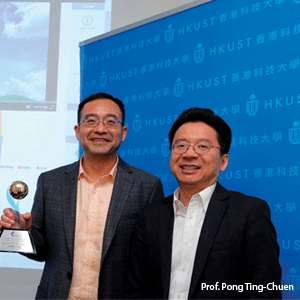
Prof. PONG Ting-Chuen
Since the launching of Massive Open Online Course (MOOC) by Coursera and edX, the two most popular global MOOC platforms in 2012, tens of millions of students have enrolled in thousands of courses offered by top institutions around the world. The Hong Kong University of Science and Technology (HKUST) was one of the first universities in Asia to form partnerships with both Coursera and edX. HKUST joined the MOOC community with the aim to develop innovative, technological and pedagogical approaches for delivering effective teaching and learning through both online and on-campus education. So far, HKUST has offered 30 MOOCs on Coursera and edX, and attracted over one million registered learners from over 180 countries. These MOOCs cover different disciplines including Information Technology, Social Science, Life Science, Mathematics and English Language. These MOOCs are in general very well received. In 2016, the MOOC on “Introduction to Java Programming” has been recognized as one of the top ten most popular courses among over 1,000 courses offered on edX by top universities around the world.
One major difference between a MOOC and an online video like those that could be found on YouTube or Ted Talks is that a MOOC is structured as a course which allows learners to participate actively in the learning process through online activities and assessments such as online quizzes and discussion forums. MOOCs also go beyond just offering content–a MOOC platform would allow all learning activities, including every click and every keystroke made by the learners to be recorded. [CIOS_QUOTES_REPLACE]
The recorded activities would allow analyses to be performed on the learning behavior of learners.
Since 2013, a huge amount of data has been collected from our MOOCs. Such data sets have much finer granularity than the available data in traditional classrooms. New MOOC data types have been defined for the data collected from MOOC platforms, including click stream data on how students watch lecture videos, forum data on what students post and how they interact with each other, and performance data on how they perform in online assessments. However, such data are large, complex and heterogeneous, posing special challenges for analytics. In addition, the end users of the analytics systems such as instructors, students and education researchers usually have little or no knowledge of data analytics techniques.
The HKUST team led by Professor Qu Huam in developed a set of intuitive, interactive and comprehensive visualization tools. These tools are integrated into a platform, named VisMOOC aiming at developing easy-to-use visualization techniques that enable the end users to analyze the data more intuitively and efficiently. HKUST’s objective is to use the results of the learning analytics to better understand how students learn and to provide just-in-time feedback to instructors for enhancing their delivery of teaching and learning.
Instructors have made use of the results of the learning analytics for improving the development and delivery of MOOCs as well as blended learning courses on campus.
In summer 2016, a pilot program was conducted using an innovative extended flipped approach for the offering of a blended learning course which combined MOOC and face-to-face classroom instructions. The idea of the extended flipped approach is to allow students to first finish a MOOC, and an assessment in the form of a proctored examination is then conducted to evaluate the performance of the students. Students who passed the examination will be allowed to participate in a two-week face-to-face session which reinforces student learning through active and collaborative learning based on the results of the learning analytics. Students successfully completed all the course requirements would earn academic credits for the course. The program was offered to a mixed of students from HKUST, a Mainland Chinese university and secondary schools in Hong Kong. Student feedback from the student feedback questionnaire was extremely positive with scores in the 90s out of 100.
We believe that the techniques and results developed through these pedagogical and technological developments would have the potential to realize the educational goals envisioned by Confucius over two thousand years ago to provide education for all)and personalized learning (through the use of MOOCs and learning analytics.
