

A featured contribution from Leadership Perspectives: a curated forum reserved for leaders nominated by our subscribers and vetted by the Construction Tech Review Advisory Board.

James Cook University
The Rise of the Platforms and the Evolution of the Crowd

Geoff Purcell
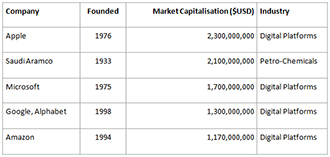
• Note, that Facebook (founded in 2004) was in the top five but has recently fallen significantly in value to now be valued at $0.35 Trillion) andin China, AliBaba and 10Cent are now dominant platforms within that closed market.
• None of these four Digital Platforms existed 50 years ago. Historically companies like General Electric, Exxon Mobil, Johnson and Johnson, and Walmart dominated the global marketplace for decades, if not centuries.
• Digitisation has compressed the market dominance of industrials from centuries into decades and from decades into years. It has changed our world and will only continue to make a greater impact until the next technology wave makes digitisation as redundant as the steam engine is now for travel and for industry (nothing more than a novelty).
• The acceleration of digitisation in the past decade has been driven by a conflagration of logarithmic (Moore's Law) increases in sheer computing power, increasingly ubiquitous networks, and more recently the rise of the "crowd".
o Artificial Intelligence – while the term AI was first used in 1956, the sheer amount of computing power that is now available cost-effectively, and the rise of the cloud have created access to vast amounts of computing power at very low costs of entry and exit.
o Machine Learning - the move away from prescriptive programming to the technique of supervised learning. Businesses have a big opportunity to apply supervised learning to business problems. If you give a machine thousands of labelled examples of "this is a dog" and "this is not a dog" the machines will now "learn" to identify dogs pretty well.
o Pervasive Internet – the emergence of smart devices and pervasive 4G and emerging 5G networks enables most of the population to get access to information whenever and wherever they wish to.
o Crowd – platforms have been increasingly deployed to enable consumers to access digital subject matter experts in any discipline on demand, cheaply and easily.
• What does this mean for commercial organisations?
o Digitisation and the rise of platforms have seen traditional industry boundaries, products, and services progressively disappear. Porter's Five Forces (a model that was first published in 1979 to global acclaim) which identified and analysed five competitive forces that shape every industry and help determine an industry's future and the organisations within it, is becoming all but irrelevant now. Apple, Microsoft, Google, and Amazon all compete and succeed in multiple (traditional) industries - fulfillment, music, computing, entertainment, cloud, etc. Equally nimble young start-ups can destroy a traditional industry within months or years (Uber, Airbnb, etc).
o Business Process Automation (BPA) that is morphing into Intelligent Automation (IA) is both a definite and exciting opportunity for all businesses, regardless of industry and of product or service offered.
o Digital products can be re-produced and delivered at zero (or next to zero) marginal cost. Once a digital product has been developed, it can be distributed at close to zero cost.
This causes the supply curve to flatten close to zero - suppliers of purely digital products will gladly offer another download (or another million downloads) of a digital good for the smallest price or for free because the cost of supplying a marginal product is close to zero. For example, millions of computer and smartphone users can download free apps, view Google Maps, access Facebook, and use a staggering variety of “free” online services, at close to zero cost for the supplier in order to create market share.
Digital suppliers can then leverage the concept of complementary products - if a supplier has supplied an app. at no cost (e.g. Shazam to identify the music you like) and built substantial market share, consumers may then pay a price to leverage the complementary products (e.g. buying the music they Shazam'ed from iTunes), creating a revenue stream for the supplier.
o Digital platforms often supply a Software Development Kit (SDK) to enable thousands of software developers to build apps. on the platform. This strategy both outsources the applications development to "the crowd"and provides a much richer experience for the platform consumer. If consumers choose to pay a developer to buy an app. the platform provider takes a margin and creates a further complementary product revenue stream. Commercial organisations should consider this strategy in leveraging platforms like Freelancer to outsource the development of features and functions faster and more often, for their consumers.
Digitisation and the rise of platforms have seen traditional industry boundaries, products, and services progressively disappear
o Commercial organisations with really tough challenges should consider platforms like Topcoder, which has a community of approximately 400,000 software developers around the world. These developers have come to the platform, at least in part, because they enjoy working on really tough challenges. In these communities, commercial organisations articulate the challenge and let the community solve the problem, quickly and efficiently.
o Platforms such as Topcoder, InnoCentive, and Kaggle make it possible for commercial organisations to harness "the crowd" and the skills of people that they would never reach, without the platform. The Linux operating system (now comprising some 25 million lines of code) and Wikipedia are developed using these crowd-sourcing strategies. Harvard Medical School used a worldwide contest to generate new hypotheses for curing and treating Type 1 diabetes. Within six weeks, it received more than 190 submissions. The 12 winners included an undergraduate student in chemistry, a retired dentist, a geophysicist, and a high-profile genetics researcher with no prior background in diabetes.
• To conclude, digitisation has witnessed the rise of platforms to become among the most valuable companies in the world. This has created opportunities for commercial organisations to think and work differently by utilising these platforms to create new products and services, and to build them faster and more often using the crowd.
